Monday, December 12, 2022

How much is too much?

I spend a lot of time musing over questions about "enough". It turns out I'm the person you all should want to win the lottery because I'd be spending a large portion of the winnings on others.

Of course I can't stop there. Lately I've started wondering about the concept of having "too much" money.  Just where is that line, and how do you know when someone has crossed it? That's a really tricky problem. It's not like you have X dollars and when you add one more there's a bunch of flashing lights and alarms go off.

So I tried a little thought experiment and here's what I came up with.

The US median annual income in 2021 was $70,784.  Clearly the median isn't too much, so let's go nuts and multiply that by ten thousand.  That gets us just over $700 million.  Is that too much? 

A person needs a place to live and food to eat. Let's fill those needs in the extreme.

Housing


432 Park Avenue has a penthouse apartment. It has 6 bedrooms, 9 bathrooms, and 8,255 square feet of living space. It recently sold for $169 million and is possibly the most expensive apartment in New York.


But what if you don't want to live in New York? Let's add 10000 Santa Monica Boulevard to our shopping cart. It only has 2 bedrooms and is not for sale, but you can rent it for the year for about $359,000.

Food

I could have tried to figure out average meal costs and such, but I realized it'd be a lot easier to take the cost of a meal at the most expensive restaurant in the US and use that. If we chose to eat anywhere else or cook our own food then it can only be cheaper than that.


Masa in New York City has three stars from Michelin, and the average bill is $1,300.  Eating there every single night for a year would cost $474,500.  We'll double that to be $949,000 so we have include lunch money.

Travel


Since we have places to live in both New York and LA, we'll need to get from one to the other. If we decide to make the trip every single day of the year that would add up to around $918,000. First class of course, and it comes with a frickin' bed.

But sometimes you just don't want to be bothered will all the other people on a plane, or maybe you want to go somewhere else, so we'll throw in a private jet for $100 million and hire a pilot for $100,000 a year.

Vacation

But jetting between luxurious apartments in NY and LA can get so exhausting, so let's add a vacation home to get away from it all.


The most expensive home in Palm Beach Florida rests on 2.25 acres of land, with 150 feet of direct beachfront. It includes 9 bedrooms, 12 bathrooms, and a total of 21,000 square feet of living space, all for a price of $140 million.

And to get further away from it all we'll buy an island.


For only $50 million we can buy a 430 acre private island resort in The Bahamas.

To get around in the Bahamas we'll also throw in a private 140-foot yacht for $20 million, and hire a captain for $2.5 million per year.


[I'm not sure why the yacht captain gets paid so much more than the plane pilot. Working hours maybe?]


Charity

There is a small matter here of Noblesse Oblige. If we're so wealthy that we can buy all this stuff it's only right that we give money to charity, so we'll give away a thousand dollars a day. Of course that would eat into our busy schedule, so we'll hire someone to do it for us and pay them a thousand dollars a day. That totals $730,000.

Too Much

After paying all of the above, a person making ten thousand times the median US income would still have over $200 million left over. 

They would also have ownership of a penthouse in New York, a mansion in Florida, an island, a plane, and a yacht, so they wouldn't need to buy them again the next year.

No one needs that much money. No one can even really use up that much money. I would say an annual income of $700,000,000 is too much. 

... so when I look at the annual incomes (2019) of some of the wealthiest people, I'm left struggling to conceive of what they do with their wealth.


Sunday, July 24, 2022

Why Shopping Algorithms Are Terrible

Generally I've had very little luck with mainstream sources for men's clothing.

(it all seems to be the usual dark color range of navy/burgundy/gray and lots of plaid - By All the Great Powers Put in Their Drinks, I despise plaid - men's fashion sucks)


I've tried.  I mean I'm an Übergeek, so I should be able to hack the system to find what I need, right?

Did you know that Amazon has all sorts of interesting code set up to prevent you from automating searches on their websites?  

Did you know they also took away the ability to exclude keywords in searches?  It used to be that you could search for "short sleeve shirt -plaid" and you wouldn't see any plaid.  The Plaid Cartel must have got to Bezos, 'cause that's long gone.

I even tried a couple of the "Personalized Stylist" shopping sites. They're maybe a tiny bit better, but that's only because they're not as impersonal about giving bad recommendations.

Something I've taken up lately is doing an image search when I'm looking for non-plaid shirts (men's fashion sucks) using pictures of shirts that I like.


Not Plaid


This works surprisingly well at finding colors and styles I like ...

Also Not Plaid

... but that's only half the battle (or maybe one-third).  I don't like the feel of synthetics, and so far I haven't figured out how to add in keywords to exclude.  Then there's the additional problem that I'm unwilling to pay $180 for a frickin' shirt.


Today I found a shirt I liked the look of (but not for $110) on an obscure website, and then I realized it didn't matter because it was out of stock ... and so were the shirts on either side of it.


In fact almost everything they have listed in the store is out of stock.


I think the only thing they actually had in stock was this one, and even though it's not plaid I still don't want it.


But all of this is somewhat aside from the point.  The question I keep coming back to is, "Why are the shopping algorithms so terrible?" ... and the answer is "Because they're designed to be terrible."

Let's say you run a shopping website with eleventy-billion visitors each day, and you program a special search thingy to help them find exactly what they want every single time.  Everybody wins, right?

Well, no.  Your marketing people come to you and show you the numbers about how some products have a higher profit margin than others.  A lot higher.  Worse, they also show the same numbers to the board of directors or the investors or whoever.

Now you could keep things the way they are, but the company would (theoretically) earn higher profits if they showed the shoppers the higher-margin items first, and not let them exclude anything they know they don't want.  That increases the odds that anyone who doesn't have gobs of time to waste scrolling through  thousands of ugly plaid shirts will give up and buy a more profitable one that's not quite as ugly as the rest before they get to what they really wanted.

... and if you don't change things to make the extra profit you'll have to explain that decision to the board and investors.  Good luck.

This is the digital equivalent of how grocery stores put the higher-margin items on the endcaps, and the lower-margin stuff on the top and bottom shelves in the middle of the aisles.

Paid advertising and recommendations on the site make the problem even worse, and this effect also shows up in the selections offered for every streaming video service.

I'm not sure what, if anything, can be done about it all though.

Friday, June 17, 2022

Iron Chef and why Alton Brown clearly doesn't get it

Real Iron Chefs - accept no substitutes

I don't remember the first time I saw the original Iron Chef, but I do remember how it felt.  Yes, there was confusion and amusement in the mix, but mostly I was filled with excitement and curiosity.  I still love the show, and am hopeful every time there's an announcement of a new version.

Of course my hopes are crushed every time.  I suspect the reason is that a large portion of the audience (along with the new shows' producers) are looking for something in the show that is very different from what I want to see.


The Real Thing

Here's the thing; in spite of the bizarre trappings, the costumes, the music, and the occasional hokey "plots", the original program was all about the food.  It focused heavily on the preparation and presentation, it emphasized the chefs' skills and specializations, and would always try to explain the "how", "what", and "why" of the chefs' decisions.


... even Sakai's failures were amazing

It was almost like they weren't even aware of the costumes or absurdity of what they were doing.  They had cooking to do!

The shows had me hooked.  I like learning about different cuisines and it routinely illustrated the differences between historical and regional cooking styles.  

I like learning about different cultures and the show provided all sorts of insights into Japanese culture (such as when the actress made a comment along the lines of, "I usually like crab brains fried, but that looks fantastic").

The show was even downright practical.  As a self-trained cook, I ended up learning some actual, useful cooking techniques while watching. 

Then along came the US food celebrities and good old American corporate marketing.


Morimoto is ok, but the other two ...

All Hat and No Cattle

Starting with Iron Chef America the focus was no longer on the food.  Instead it shifted to the chefs and their egos.  The American producers seemed to care only about the style and not the substance.

There were still plenty of camera shots of food cooking, but they were a lot shorter with lots of cuts.  Put it to some catchy, inspiring music and they'd be a perfect cooking montage for a romantic comedy set in a professional kitchen.  There was still "what" but much less "how" and "why".  We got lots of quick flashes of something flaming in a pan, some frantic chopping, stuff in a blender, and then - BAM! - there's a final dish.

I rarely, if ever, could learn anything from the chefs because I could never actually see what they were doing.

And the quality of the "Iron Chefs"?  Well ... Morimoto aside (because he's from the old show), I think it's safe to say they've been less than stellar.  Yes, Flay has a chain of restaurants, but they seem to all be hamburger joints.  Batali was forced to sell his interests in his restaurants because of his bad behavior.  Cat Cora has built a resume of unimpressive, failed restaurants.  Michael Symon's places are mostly bars that sell hamburgers.

Others on the show have had more successes and better fit the title of "Iron Chef", but compared to the chefs in the original show it starts to look like they're much more interested in stardom and business opportunities than actually cooking.

Side note:  I'd have watched "Beat Bobby Flay" with a lot more interest if it had involved baseball bats.


The Return?

Once again Iron Chef has risen anew from the cooking fires, and this time I'm feeling mostly trepidation with just a hint of hope.

There's good reason for the trepidation.  When asked about differences between the new show and the previous version, Alton Brown noted, "The second one is that because it’s streaming, people can binge the whole thing and that allows us story arcs that are longer than just one episode."

Story arcs?  [*insert sound of a forehead being slapped*] It's supposed to be a frickin' cooking show, Alton!  Any "story arcs" are supposed to be a garnish, not the main course!

I can only assume Alton sees the show as flashy entertainment - rather odd considering how he's positioned himself as doing educational food programming in the past.


Taking one for the team

The only episode of Iron Chef: Quest for an Iron Legend that I've watched so far is Episode 4: "Battle Medieval."  I skipped ahead because of my interest in the cuisines of medieval Europe.  My opinion is ... mixed.

Let's get the most painful part out of the way first.  Whoever decided that they should have a "medieval" theme needs to be moved to a job where they're not allowed to make decisions.  It was painfully clear that none of the chefs have any amount of knowledge about medieval cuisine ... or even medieval history.

To make it simple, almost every single sentence uttered on the show that included the word "medieval" was completely and depressingly wrong. 

Yes, I could write thousands of words of explanation on why each sentence deviated from well documented reality, but there's no point.  The people who need to read those words have no interest in doing so.  All the information is already out there and a lot of it is in a form that is incredibly easy to access and understand.  You can lead a horse to water ...


There were no utensils in medieval times, hence there are
no utensils AT Medieval Times. Would you like a
refill on that Pepsi?
(this was hysterical to me until I realized people actually believe it)


There were other things about the episode that bugged me.  For example, there's still too much of the "music video" editing style, and they really need to either get rid of the "Chairman's nephew" or tell him to dial it back.  The constant mugging for the camera reminds me of some of my classmates back in 5th grade, and it was only entertaining back then because school was boring.


On the Up-Side

The cooks actually seem to know what they're doing, especially Dominique Crenn and Curtis Stone.  Kristen Kish presented herself well, but given her background she spent way too much of the show being upstaged by Alton.  He could improve his reputation significantly by admitting when he doesn't know something and letting her provide the answer rather than just making something up.

Medieval history horrors aside, I'm willing to watch at least one more episode.  The food was interesting and I didn't hate the chefs.


Saturday, May 28, 2022

On Impermanence and the Pursuit of Happiness


Once upon a time there was the Perfect Rum ...


It was golden-colored and not too harsh, with notes of caramel, marshmallow, and maybe a hint of orange.  It even had such a reasonable price that you wouldn't feel bad about using it in mixed drinks.

It came in a cool, hand-blown glass bottle with a real cork cork and a Hoti Buddha medallion ... I'm still not clear on the reasoning behind the medallion, but it was cool so I didn't care much.

It was bottled in Anguilla by a little company that bought rum from distillers, blended it, aged it, and put it into the cool bottles.  They even hand-numbered each bottle.

Sadly, all good things must end, and the Perfect Rum was no exception.  The original owner of the company liked Anguilla and wanted to provide jobs there, but when he died the new owners decided to move production to Guyana in order to cut costs and increase profits.

The rum that had been my default for years no longer tasted as good.  It was still a bit better tasting than Bacardi, but so is most shaving cream.  After a couple of disappointing months I realized I needed to let go of the Perfect Rum that no longer was, and try to find a new one.

I haven't found it yet, but this one is close.

Don Q Reserva isn't bad.  It's golden colored and has a nice flavor of caramel, not too much of a bite (though more than Pyrat used to have), has a cork (though not a real cork), and comes in a nice bottle (though nowhere near as cool as the Pyrat bottle).  It also is reasonably priced.

It's not the Perfect Rum, but that no longer exists.  It's good enough for until I find the New Perfect Rum.


Monday, April 4, 2022

The Scam of US Medical Pricing


If you want some fascinating reading, do a web search on the "real" cost of x-rays.  You won't get any good answer, but you will spend however much time you can stomach reading case after case involving the wildly different prices being charged by various care providers for something that is surprisingly cheap anywhere in the civilized world. 

Of course some will point out that "No one really pays that much for an x-ray".  That's true, but only kind of ... sort of ... maybe not.

Let's go with a hypothetical example based on someone else's misfortune:

For whatever reason, J. Schmoe needs a chest x-ray.  Being blessed with endless patience and time, they call ahead of time to determine what the price will be, and after being repeatedly told, "We don't know what the price will be.  Come in and have it done and we'll find out after you're billed," they eventually find the one person who will quote a price:  $517.

Thinking:  Ya know, given how much I've had to shell out for testing and surgery and all in the past few years, that really doesn't sound all that bad.  Wait ... no.  It's total crap.

In some states or at some providers there's a discount you can ask for if you're paying cash rather than going through insurance.  If that happens to be the case the amount instantly drops to something like $310.

Think about this.  You know the provider isn't going to be losing money by charging you $310 for the x-ray, so the real cost is somewhere below that, and the $517 is some kind of magic markup they send to the insurers.  Why would they do that?  Let's see ...

Since J. Schmoe has health insurance the super-secret discount won't work.  They go ahead and get the x-ray, pay something like $36 as a "co-pay", and then wait for the bill.  This is where it starts getting really weird.

The care provider and insurance company have a chat among themselves.  The length of the discussion, and who wins it, largely depends on; 1. how big the provider is, and 2. how big the insurer is.  The loser of the discussion is always going to be the patient.  To add insult to injury, this part of the system involves a heck of a lot of people and time, and in itself significantly adds to the cost of healthcare - which is why a cash discount exists.

Eventually J. Schmoe gets a statement/explanation of benefits/bill that looks like one of the pictures below.  

Explanation of Explanation

Service:  The thing done.  Usually this will include an insurance code, which if you go down that particular rabbit-hole can lead to some amusingly specific insurance diagnostic codes which create more questions than they answer.

Provider Charged:  The number the provider came up with for the total bill.  Note that this might be different from what was quoted because of odd little fees added in.  There may also be situations where the amount quoted was for the procedure itself, but there was a separate bill for some other part that the patient couldn't avoid.  For example a single operation can involve separate bills from the hospital, the surgeon, the anesthesiologist, and the hospital's pharmacy.  This really ticks me off too but it's a whole separate rant.

Allowed Amount:  This number is essentially a "screw you" from the insurance company to everyone else.  They're saying, "I don't care what the provider charged, we're going to pretend the bill they sent only said this number."  I wish I could get away with that.  More on it below.

Insurer Discount:  This amount is really just showing who won the dick-measuring contest between the provider and insurer.  If the discount is high then the insurer won, otherwise the provider won.  The fact it exists at all is bad for everyone else.

Patient Liability:  The amount the patient ends up paying.  Sometimes it can be appealed and brought down, but the odds of that aren't good.  Of course it's still worth trying because a lot of crappy insurers automatically deny everything in hopes the patient will just give up and let them keep the money.


Low Suckage


This is likely the best possible outcome for the patient because the insurer paid for everything other than the co-pay.  This is also the least likely outcome, even for people who have good insurance.  Why?  Well if you were an insurance company would you want to pay anything if you could figure out a way to avoid it?

Moderate Suckage


This is like the Low Suckage results, except the patient probably has an unmet deductible.  Once that's met the insurer would (hopefully) pay more.

Major Suckage


Here something interesting is going on.  The insurer is insisting the bill is only $360, that they have a deal with the insurer to cut $150 off of that, and then they're paying the rest.  But they're going on to say that the patient's part of the bill is really based on the full amount charged by the provider rather than the numbers they were playing with.

This is called "Balance Billing" and is illegal in some states/situations.  Sometimes insurers actually pay attention to those laws, but of course "mistakes" occur.

Ok, here's the "fun" part (and by fun I mean totally infuriating):  the patient liability at this level of suckage is actually more than it would have been if they had payed in cash with a cash discount and skipped the insurance altogether.  The insurance company would have preferred that too as it means the patient is paying for insurance they're not using.

But wait ...

Remember how I said the provider was certainly still making a profit when they gave patients a cash discount price of $310?  You can also be reasonably sure they're making a profit from the $174 payment after all the shenanigans are done with.

You know who pays the full amount?  Anyone who doesn't have insurance and can't afford to pay in cash.  For a "small" bill, say a once-per-year urgent care visit for a strep test that totals $150, they can pay it off over time.  For the big stuff though, the obscene overcharging gets added in as real numbers for the big providers to play financial games with (e.g. written off as bad debt for a tax deduction or to bolster tax-exempt status, or folded into overhead costs to justify increasing prices).

And then it all gets worse when it's noted that a free-standing private office provides that same x-ray with the same quality of service for a total of $73 ... in cash.  Pity J. Schmoe didn't know about that beforehand.

Oh, and if someone can't pay the odds are they'll just not have it done at all.  This means they're more likely to end up with more expensive medical issues, or just plain die.  But of course we're not talking about anyone important, right?  It's not like those are real people.  Yes, in case you missed it, that last bit was loaded with sarcasm.

Solution?

I'm not going to pretend to have all the answers, and I'm not going to say that government-run universal healthcare is the only option (though it is an effective option).  But I think a good starting point is to level the playing field between insurers, providers, and patients. 

The "Allowed Amount" and "Insurer Discount" parts need to go.  The cost for a frickin' chest x-ray from a provider should be the same regardless of who is paying for it.  Providers should be legally required to charge a consistent for a given service (they've got all those codes, after all), and insurers should be legally obligated to base benefits on that amount.

Thinking:  I'm still kind of curious if I can start using those tactics though  ...  Sorry, Fredonia Gas & Electric.  The Allowed Amount for my monthly utility bill is $120, but you'll be happy to know I'm paying that amount in full!

Thursday, March 10, 2022

Nuclear Power ... [Insert blank stare here]


Way back when I was shorter, I thought nuclear power was the future.  Then I learned more and I realized it had serious problems and I jumped on the anti-nuke bandwagon.


But then I learned more about nuclear energy and radiation and pollution and ecology and, believe it or not, became hesitantly pro-nuke.

That however was many years ago, and since then I've not only learned more about nuclear energy and radiation and pollution and ecology, but I've also learned a lot about human behavior, economics, business, and politics.  There have also been two big nuclear accidents in that time.

Now when I hear someone say "We need nuclear power to take up the slack while we transition to renewables to stop global warming," ... and I don't know about you but I've heard this a lot over the past few years ... I'm liable to stare at them and wonder about what they've been smoking.

If I feel like making the effort, my answer to them would be along the lines of, "No.  We really don't."


The Problem

Odds are I don't have any information off the top of my head and can't google and read fast enough to counter the gallop that would follow, most of which seems to be the "everyone knows" kind of stuff that sounds suspiciously like it was written by the National Atomic Boosters or some such group.

So ... this post is for future me to point them to.


Two of the biggest and most common arguments for why we need nuclear power are:

1.  We don't have enough space for all the solar panels and wind generators.

2.  We need extra, reliable power for when the wind doesn't blow and the sun doesn't shine.


The short answers for these are:

1.  Bunk.

2.  Bunk.


Of course that won't go over very well as it's uninformative and not very friendly.


1. How much do we need?

That's a tough question, and I'm sure if you ask a dozen politicians you'll get five hundred answers.

A quick search got me a number for 400GWh for the annual power consumption in the US.  That's a lot.

It got me thinking about where would be a good place to put solar panels that wouldn't be adding to negative environmental impacts (a lot of pro-nuke people bring this up like it's some kind of "gotcha" and like somehow nuclear energy has no effect on the environment).

You know what we have a heck of a lot of here in the US?  Roads.  Specifically, the Interstate Highway system.

So, look up some numbers, do some math.  Not trying to solve problems, mind you.  I just want to make sure I'm thinking on the right scale.

We've got 46,876 miles of Interstate Highway (an oddly specific number, eh?).  A 3' x 6' solar panel on average puts out around 250W.  That means if we put a row of solar panels in the median, in both directions, [ math math math probably got some stuff wrong math ] it comes up to around 40GWh.  Yes, that's about 10% of what we need, but it includes using zero new land and would be pretty easy to tie into the existing grid because all roads lead to the grid.  That's a new saying I just made up.  Feel free to use it.

What that really means is the scale is right.  We might not want to actually do it but we've got a lot of other options as well so I'm very sure 100% renewable is both possible and feasible.

Is there anyone else out there that says it's possible and backs it up with better numbers?  Turns out, yes.  An article was published in Nature last year saying 100% could be met using just rooftop solar alone.  Do I understand all the math in it?  Hell no.  Did I look for articles to the contrary?  No, but to be fair I really didn't look hard for this article either.


2. How much do we need?

This line of thought is much less about the numbers and more about just plain easy.

"Yes, we need X units of power per day, but demand isn't evenly spread out.  So with the variability of renewables how are we going to fill the gaps?  We don't have any way to store sunlight or wind for when we need it."  Notice how they've wrapped two arguments up into one?

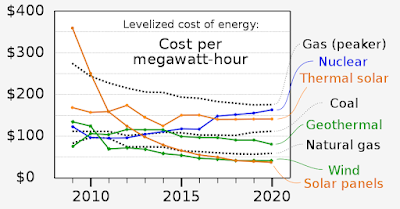
Well first, we don't have to limit ourselves to X units of production.  Here's a really neat chart I found.  It shows that for the cost of nuclear power we can build a heck of a lot more renewables.  


So instead of developing enough sources to generate X units of power, we make it 2X, or maybe 1.5X, or whatever.  We end up with plenty of power and it's still a hell of a lot cheaper than building new nuke plants.

And storing the extra power?  We don't have to try and keep sunshine and wind in our pockets.  We can actually use electricity generated by renewables to make hydrogen, which I suspect can be stored in ways similar to natural gas, and can be burned on demand to generate electricity in ways similar to natural gas ... and if you're going to complain about efficiency for that step just bump the factor up for X a bit and all is good.

We need nuclear power?   No. We really don't.

Disagree with me?  Cool.  Show me the consensus of experts in the field and I will change my position.

Want to just call me a poopyhead?  Fine.  Do it somewhere else though.  I don't have time for that.


Monday, March 7, 2022

Refugees, Asylum Seekers, and Immigration

Continuing my recent theme of stating positions that I know a heck of a lot of people aren't going to like, today I thought I'd alienate people by talking about immigration.

As with all of my viewpoints, I'm happy to entertain the possibility that I am wrong, and if presented with a cogent argument supported by the real world there's a good chance I will admit my mistakes and change my position (it's happened before, and I hope it will again because that would mean I'm still learning and growing).

With that said, here we go ...


Background

Way back when, before any of us were alive (specifically before 1875) , the immigration policy of the US was pretty much, "Welcome to the United States."  There were some vague requirements about being "of good moral character," and non-whites only got the right to citizenship five years earlier, but that was pretty much it.  If they found their way to the US, they could become "one of us."

Of course we all know such a state couldn't last long, and a steady stream of restrictions were added to just who could and couldn't immigrate.  Some of these seem reasonable on the surface, such as the bans on criminals or people carrying contagious diseases, but others start to edge into the category of "keeping out undesirables".  Polygamists, anarchists, and beggars quickly made the list.

Then in the early 1920s, as the sources of immigration shifted from northern Europe to other regions, all sorts of caps and quotas were implemented.

From that point on it's pretty much all down hill.  Whether intended or not, US immigration policy was (and essentially still is) geared towards maintaining a degree of whiteness.

There have been attempts to reform the policies with the stated aim to "help reunite families" or improve "border control," but unsurprisingly they haven't been that successful.

My viewpoint is that the reason attempts at reforming the process have failed is that they're like trying to repair a broken clock by changing when you have lunch.


Yes, the current system is expensive, problematic, and somewhat ineffective.  It's also unnecessary.

If you do a web search on "economic impact of immigration" ... heck, I'll even make it easy on you, go ahead and click the link ... you get references to countless studies (well, I'm not going to count them) all saying the same thing: immigration is great for the economy.

Not to surprising really if you take a moment to think about it.  If you bring in more people then there are more people who need food, clothing, housing, etc.  With more consumers you get more business, and that means more employment, and more more more more more.  Life is good, right?

Whaddabout ... ?

What about crime?  Searching for "crime and immigration" (I'm so helpful!) returns heaps of studies showing no causal link between the two (thought I've seen some that show recent immigrants are more likely to be the victims of crime).

Ok, how about protecting our vaguely defined "Cultural Identity"?  Ugh!  Setting aside that this is usually used as a euphemism for "whiteness," just what kind of identity are we talking about here?  The US is a bunch of people from all over the world living on land taken by force from those who lived there before.  A lot of the people sent over from Europe were criminals, exiles, debtors, religious nutcases, and people who were just trying to get away from where they used to live.


The only real cultural identity we have as a nation is that of the scrappy, mixed breed dog that will continue to chase huge trucks because one day it's certain it will catch one and win.


Why isn't anyone concerned that
we're all being boiled alive?


Our national language?  No.  Just don't.  Remember that Benjamin Franklin wanted the national language to be German?  If we're going to pick one single language for everyone in the US, I would propose either a language that originated on the frickin' contenent, like maybe Zuni, or one that's completely made up and isn't anyone's native language.  But really, no.  Just no.  We don't need to declare an official language or keep people out who speak something else.

The "Solution"

When you find yourself doing something that is both counterproductive and incredibly stupid, most often the solution is to cut it out.  In this case that would probably work.

1.  No more quotas, limits, or restrictions.  The officer at the border looks at your papers, runs a quick check to make sure you're not on a terrorist or most-wanted criminal list or whatever, takes a photo, gives you a green-card number, and sends you on your way.

If you're not a terrorist or wanted criminal, why wouldn't we want you to come in and spend money? 

If you're going to be in the US, why wouldn't we want you to be allowed to work and pay taxes on your income?  (and no, they're not taking jobs away from hard-working real Americans.  It doesn't work that way.  Go back and read all the stuff at the economics link above)

2.  Um ... actually that's it.  There is no step 2.

Bonus

The part that really gets me is what this saves us.  I mean, aside from all the good brought about by the economic boost immigrants bring, and ignoring the really cool cultural stuff like great restaurants that serve something other than cheeseburgers (which I love, by the way!  Cheeseburgers are awesome!  But have you ever had Thibetan food?  ZOMG that stuff is awesome!).

As a bonus our government doesn't have to spend money looking for "illegal immigrants" to deport.  We don't have to keep a small, permanent, specialized military force to have roam the country, busting down doors, breaking up families, and in general being horrible people.

We also don't have the absurd humanitarian crisis of people camped out on our boarders because they're fleeing war, crime, persecution or anything else, but we want to be sure they're really deserving of asylum and not really just trying to sneak into the country to build a better life.

It would even speed up things for citizens coming back from abroad.  Right now they look at everyone's documents to make sure you're really you and not someone trying to sneak into the country to build a better life.  Instead it would be "Yup, the picture looks like you, and you're not on the bad list. Reason for visit?  Who the heck cares!  Have a nice day.  Next!"


Do I really believe this is what should be done?  Pretty much, yes.

Do I think it has a snowball's chance in hell at actually happening?  Nope.  It would let too many brown people into the country.

Tuesday, December 14, 2021

Elon Musk and Misdirection

 I've been posting more political rants lately ... sorry.  It seems that's the part of my mind that is most awake right now and the built-up anger from reading the news needs some kind of creative outlet.  Please feel free to ignore these posts if they're not your cup of rum (or tea ... whatever).


Villain of the Year

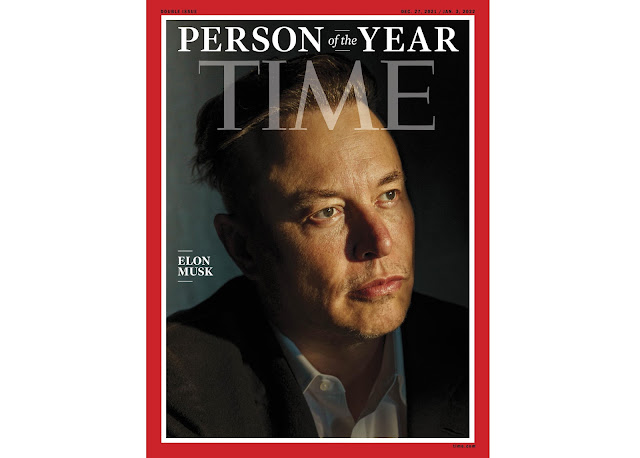
So Time magazine did this:


Of course there's been a lot of outcry from the left side of the political spectrum (including a "fixed" version of this cover that was rather pointed, but sadly I could not find it again to include it here), and not without good reason.

Musk is an ultra-privileged, white, possibly narcissistic, dudebro asshole (hereafter abbreviated as UPWPNDA).  I strongly suspect even the majority of conservatives would agree with that assessment.  He's made many decisions over the past year that were incredible insensitive and/or downright harmful.

As an example, an article on the Vox website includes the following:
Musk spent much of the first half of March 2020 downplaying the threat of Covid-19 to his 32 million followers on Twitter. (Later, he promised to build ventilators for California hospitals, although the equipment he sent didn’t prove to be all that helpful in ventilating Covid-19 patients.)

Musk continued to spread misinformation about Covid-19 throughout the rest of 2020, again to his 32 million Twitter followers. Later, he actually contracted the virus and had to miss a SpaceX launch.

Musk rushed to reopen a Tesla plant in early 2021, leading to hundreds of new coronavirus cases.

Musk frequently makes tweets that bounce Tesla’s stock price all over the place — and who can say why, in the end?

Musk stuck his nose into the rescue of a group of Thai soccer players who were stuck in an underwater cave, then called one of the actual rescuers a “pedo” after said rescuer criticized Musk.

Then there's the fact that he pays relatively little in taxes.  This from an article on The Hill:
Elon Musk paid less than $70,000 in federal income taxes between 2015 and 2017, and he did not pay anything in 2018, according to recent reports.

He did pay his taxes in 2016 by exercising more than $1 billion in stock options.

He lives off loans made from his stock options, meaning he doesn’t take a salary from his company.

So yes, there's a "valid" reason he doesn't pay much in taxes, but the methods he uses simply aren't available to average (or even the majority of above-average) Americans.


All of this is a huge misdirection.  If I were conspiracy-theory minded I'd see evil machinations  manipulating the public mindset, but that's too much mental work for me so I'd rather just chalk it all up to a system that rewards complacency, mild corruption, and political inertia.

Of all the UPWPNDA billionaires in the country, Musk is possibly the most beneficial to society in the long term.  By roping in money from a lot of other UPWPNDAs to spend on his quirky projects, he has actually pushed development of electric vehicles, solar energy, space exploration, manufacturing, and mass transit forward well beyond what would have been expected.  And much of this new technology is of huge benefit in reducing or reversing the effects of climate change.

There aren't many other UPWPNDAs who come anywhere close.  Most of them instead generate their billions in low-tax incomes through promoting fossil fuels, pillaging natural resources, and sucking cash out of the pockets of workers and/or tax dollars from the general public.  They of course try to keep a lower profile so they're less noticeable.  Musk's schemes require more investments though so he has to stay visible.

That makes him a very easy and tempting target for criticism (deserved or otherwise).

So let's think about something here.  The despicable things that Musk does are generally legal (or enough in a gray zone that he can get away with them for a while until a court tells him to cut it out and fines him a bit).  The same goes for Bezos, and the same went for Steve Jobs. 

Of course that doesn't make their actions right, just legal.

Buy what would have happened to them if they didn't do such scummy things?  Odds are they would have lost some or all of their financial backing, been removed from their CEO positions, and possibly even sued by their (now former) financial backers for not making choices in the investors' best interests.

In other words, the UPWPNDAs are rewarded for doing bad things and punished for not doing them.

The Real Problem

What we need to be doing is keeping track of these things and not using them against the UPWPNDAs (... ok, maybe not using them quite as much - the UPWPNDAs still need to repeatedly hear that what they're doing is wrong), and instead screaming all this at the top of our lungs at our state and federal politicians.

If the UPWPNDAs are using their position to promote public health misinformation then laws against knowingly spreading that kind of misinformation need to be created and enforced.

If the UPWPNDAs are making decisions that put their employees at risk physically then workplace safely laws need to be updated and enforced.

If the UPWPNDAs are avoiding paying their fair share of taxes then the tax laws need to be updated and enforced.

We can't fix this kind of problem by yelling at the UPWPNDAs when the system is constantly demonstrating to them that what they're doing is right.

Like it's not going to help things if you leave candy lying around everywhere and then yell at a toddler for eating it.  You've got to pick up all the candy and put it where the toddler can't get it.

We need to fix the problems in the system so the UPWPNDAs will stop acting like toddlers.


Friday, December 10, 2021

Thoughts on Minimum Wage

Let me preface this with a note:  I used to be a Republican.


I grew up in a family that always voted for Republicans.  My dad was pro-business and anti-communist.  My grandparents had a .38 revolver and were members of the NRA.  I tend to joke that I was thirteen before I learned that "asshole democrat" was more than one word.

What happened?  Dunno.  Mostly I think I started looking at the actual data and results of political policies rather than focusing on the ideals espoused by politicians and going with "what we've always done."  After a while I realized I really didn't like what I was seeing.

Because of the cognitive dissonance, I eventually had to accept the fact that I almost always sided with the policies of the Democratic party, and over the past 10 years or so I've become downright progressive.  Again, not because of the ideals and such, but because I've found what they propose is much more inline with what would actually work in the real world.

I suspect my grandparents would have shifted to the left as well, though perhaps not as much as I have.

I mentioned the above to show that I try to consider policies based on their real-world merit rather than out of habit or some sort of "tribalism".  Show me unbiased sources that reflect the consensus of experts in a field of study and I will accept their position as being the correct one.  If that consensus changes then I will follow it where it leads.


Enough Background

So ... about the US minimum wage ... it's crap.  If you look how the minimum wage has remained unchanged since 2009 while the inflation rate has averaged 2.14% per year, producing a cumulative price increase of 28.92%, it's clear that something is very wrong.

As an illustration, take a look at the table below.  It shows the minimum wage for given years, what that would be annually for a 40-hour/week, 50-weeks/year job, the corresponding per-capita gross domestic product for that year, and the minimum wage as a percentage of that GDP.


You can see the problem, right?  The GDP (overall productivity) has grown, but the actual workers' share of that productivity has been dropping like a rock.

Where's all that money going?  That's a complicated discussion on its own, but the short answer is, "Into the pockets of the richest 0.1%".

Every time I think about this I come up with all sorts of questions, and the most repeated one is "Why isn't the minimum wage indexed for inflation?"  Again, there's a lot to talk about with that so I'm going to just skip it all and propose what I think would be a fair solution.


Let's link the minimum wage to the per-capita GDP

I still have enough conservative ideals in me that I think businesses and entrepreneurs should be rewarded.  However I don't see any reason that they should take the lion's share of the profits of work performed by their employees. To me that seems to go directly against the ideals promoted by libertarians - a hard working individual should receive the majority of the benefits of their work and not have it siphoned off by others.  For some reason though, libertarians almost always side with the folks at the top of the pyramid.  Kind of baffling, really ... I mean, when you actually think about it ...

Anyway, let's go back to those numbers.  in 1965 the minimum wage was 65% of the per-capita GDP.  If you dig in a little further that seems to have been a bit of an off year, so let's round it up to 70%.  That's going to be our baseline - the average worker would be paid 70% of the value of their work.

When I phrase it that way it sounds kind of hinky, but I'll stick with it.

"But the GDP can fluctuate wildly," I hear you say.  "That would make the minimum wage fluctuate and corporations would have all sorts of trouble planning."

Yeah, whatever.  Corporations have to cope with all sorts of uncertainties and yet they are still profitable.  That said, I don't like instability either; it's messy.  So I'll add a tweak.  We'll use a rolling average of the GDP to smooth out some of the noise.

"So if we set the annual minimum wage to be 70% of a 5-year rolling average of the per-capita GDP, what would it look like?"  I'm glad you asked.


Kind of interesting, eh?  The minimum wage under this system would have been a bit lower at the start, but look at the most recent years.  That's about where progressives say it should be now (though they've been pushing for $15/hr. because that's a lot easier to sell in congress).

The best part of such a change though is that the public would no longer have to put pressure on the politicians to do the right thing.  As the economy grows the minimum wage would follow right along, and if for some reason the economy crashes or sinks it would cut back to reflect the new reality.

I strongly suspect that a lot of people won't like this idea though.


Tuesday, December 7, 2021

Warning Labels - Thin Blue Line Punisher

I've seen this sticker numerous times over the past several years - almost always on black SUVs or really big pickup trucks.  I can only hope those who choose to display this just haven't thought through all the connotations and aren't really horrible people.

This is a combination of two different symbols: the logo of the Punisher (a Marvel Comics sort of anti-hero), and the "Thin Blue Line" flag.  Each of these symbols is problematic on their own, but taken together they add a context that is very disturbing.

The Punisher 

Like many of the anti-heroes that are popular in American culture, the Punisher operates outside of the law.  This is usually justified as being necessary because of incompetence, incapacity, or corruption in law enforcement.
The character is depicted as an Italian-American vigilante who employs murder, kidnapping, extortion, coercion, threats of violence, and torture in his campaign against crime. Driven by the deaths of his wife and two children, who were killed by the mob for witnessing a killing in New York City's Central Park, the Punisher wages a one-man war on crime using various weapons. - Wikipedia


The Thin Blue Line

This symbol came to prominence sometime around 2014 in connection to the "Blue Lives Matter" response to the "Black Lives Matter" movement.  It encourages a viewpoint in which the police are somehow separate from the rest of society, and they have an elevated status because they are the only thing standing between law abiding citizens and criminals.

Together

It should be pretty easy to see why the juxtaposition of these two is problematic.  Encouraging law enforcement officers to see themselves as a separate and elite group, while holding up an ideal of doing whatever it takes regardless of legality, is a recipe for an authoritarian police force that answers to no one.  It is the very antithesis of the basic principles of justice.

Of note is how the comics have actually addressed this head-on.

This controversy was addressed in Punisher Vol. 12 #13 written by Matthew Rosenberg in July 2019. In the issue, Frank comes across two police officers who are fans of his. They take a selfie with him and show they have a sticker of his logo on their car before comparing their work to his. Unimpressed, the Punisher tears up the sticker and tells them, "I'll say this once, we're not the same. You took an oath to uphold the law. You help people. I gave that up a long time ago. You don't do what I do. Nobody does. You boys need a role model? His name's Captain America, and he'd be happy to have you.... If I find out you are trying to do what I do, I'll come for you next." In 2020, Marvel said this was their official opinion on the use of the image. - Wikipedia


Saturday, November 20, 2021

Warning Labels - Three Percenters

I saw a sticker the other day (on a black SUV, of course) and since I had to look up its meaning to be sure, I thought it might be worth using to start a series of posts:  "Self-Applied Signs that People Helpfully Use to Identify Themselves as Vile Excuses for Human Beings".


Since that's a bit too long though I'm going to just call them "Warning Labels".

I don't expect this series will make me many friends within certain groups.  I'm ok with that.


This is the symbol of the Three Percenters - a right-wing militia group.  Here's what Wikipedia has to say about them:


Like other American militia movements, Three Percenters believe in the ability of citizen volunteers with ordinary weapons to successfully resist the United States military. They support this belief by claiming that only around 3% of American colonists fought the British during the American Revolution, a claim which underestimates the number of people who resisted British rule, and which does not take into account the concentration of British forces in coastal cities, the similarity of weapons used by American and British forces, and French support for the colonists.


That one paragraph contains the two fatal flaws in the Three Percenters' beliefs;

1.  The claim they take their name from is nonsense

2.  They've somehow deluded themselves into thinking a group of self-trained military wannabees carrying AR-15s could be any kind of match for the US military.  I mean, think about it.  The real military not has things like tanks, helicopters, aircraft, drones, and really-really-big bombs.


Tuesday, October 5, 2021

I've got an idea ...


Yeah.  Facebook goes down and everyone panics.


This does show how much we rely on it though - for me it's how I keep up on all the things my friends are up to.  The odd thing is if you ask everyone who was inconvenienced by the outage what they're general opinion is about Facebook and I'm very certain the responses won't be nice.  Everyone uses it but no one really likes it.

I think I know how to fix things ...

"Right!" you say, and go read something else because you've seen this all before.


For those still reading, here are my thoughts:


1.  We need something decentralized

If it's not all on a single server and not controlled by a single company then it can't be taken out by a single problem ... and they can't control what you read or post.  It's time for the individual to take back control of their postings and feed.


2.  It needs to be secure

Cryptographically reverse polarity of neutron flow something something gazpacho.  We all know this is important but really the details will be mostly left up to the cryptonerds.


3.  It needs to be open source

Screw proprietary code.  With open source every ubergeek can be checking it for security holes (see #2) and making improvements.  This gets us back to how the programs that built the internet were made in the first place (see HTTP and SMTP).


4.  It needs to talk to Facebook

At least in the short term, any solution that doesn't hook in somehow to Facebook is a non-starter.  Nobody is going to switch to a different social media platform if their friends aren't already on it.  Checking two different platforms is a bite in the butt and folks won't do it for long.


Ok, so here's my solution:  A secure offshoot of RSS.  Maybe call it SRSS?  I'm sure someone can come up with a better, spiffier name.  I don't care as long as someone makes it.

I'm going to go into some details below, but here's the good part;  ALL OF THIS CAN BE DONE WITH OFF-THE-SHELF CODE!

Yeah, I shouted.  Deal with it.


Start with a simple Blog with an RSS feed.  Anything you post on it is a public post.  Everyone can see it and read the posts and make comments.  That part's easy.

For the private posts that only Friends can see, encrypt everything in the post using something like PGP.  Even the subject line of the blog post is encrypted.  For your friends to read it (and comment) they'll need to have a public key that they got when you "friended" them.


That's pretty much it.  We'll need a special browser plug-in for reading the SRSS "blogs" (or whatever they end up being called), a special server for creating the SRSS feeds, but that's pretty much it.  With a little extra fiddling, everything you post on your SRSS feed would automagically be posted on your Facebook account.

1.  It would be decentralized.  Some people would have their SRSS handled by a big company like they do with email, others would get it from their webhosts.  Regardless, if some idiot with a backhoe takes out a big chunk of the internet everyone else would still be able to get their social media fix.

2.  It would be secure.  Not only would it have the built in encryption thing going, but since it's not all hosted by one company it's less prone to the thing where hackers break into a single server and get away with millions of passwords and such.

3.  It would (or could) be open source.  I'm sure there would be private forks of the code, but unless they were adding something really amazing to it all they probably wouldn't do very well.  Note how all the corporate-owned extensions to HTTP have fared over the years.

4.  It would talk to Facebook ... for as long as Facebook continued to be a thing ... which I expect wouldn't be that long, because in all honesty Facebook seems to have been intentionally making our experience worse.


Minor problem:  This isn't my kind of programming.  I'm great at webcoding and PHP, and I acknowledge no one as my better in ABAP for SAP/R3 (a serious niche that I've been stuck in for the past 20+ years), but this kind of stuff is well out of my reach (ok, I could learn, but I've got a few decades of other work queued up that I really want to get to).  If no one else does this then it won't get done.

PLEASE someone make this (or something similar) a reality!

Friday, June 5, 2020

Now here's my plan ...

Like many of my friends I am fed up with the two-party system in the US.  Sadly, the system is the inevitable result of how our voting system works.  A while back I realized that the US could be changed into a parliamentary government without any constitutional amendments.

Let me be clear, I don't think this is likely at all to happen.  In fact I think there are some significant problems with this plan.  That said, I see it more as an example of how flexible (or even hackable) our government was designed to be.


Congress

First we need to switch the House of Representatives to be more diverse.  This would require changing federal and state laws - for example the 1967 Uniform Congressional District Act (which mandates single-member districts) would probably need to be repealed. Instead voters would select a party (or individual acting as a party) to represent them and the state's seats in the House would be proportionally divided up according to the results.

The Senate?  Leave them as they are, I suppose.  If anyone has good ideas for the Senate I'm happy to listen.

Presidency

Here's the fun part.  The constitution requires a presidential election every four years, but it doesn't require us to actually keep the result.

The 25th amendment allows for removing the president from office if they're deemed unable to discharge the powers and duties of his office. The amendment says this can be done by the Vice President and principle officers of the administration, however it goes on to add "... or of such other body as Congress may by law provide."  

So Congress could pass a law stating that Congress can declare the president unable to do the job.  Effectively this would be a vote of no confidence.

So every four years there's a symbolic presidential election and the winner becomes President.  Then Congress would vote no confidence and the President is removed from office (the President could object in writing but then Congress would hold another vote and it would still happen).  That means the VP would assume the office of President ... and Congress would remove them too.

The presidency would then pass to the Speaker of the House ... who was just elected to that position by the house so it would probably stick.  A new Speaker is chosen, and a new VP would be appointed and confirmed by ... the House.

What this results in is a House of Representatives that is more representative, and a presidency that can be replaced at any time.

We could still keep the presidential elections and even the Electoral College - though really there'd be no point to them.

Tuesday, March 10, 2020

Space Western - Props

A few weeks back I started running an RPG for Celeste and some of her friends.  The setting they chose was "Space Western".

While I've been having a hard time getting much writing done, worldbuilding doesn't seem to require the same amount/kind of braining.  I managed to flesh out an undeveloped planet in the sci-fi setting I've used in the past for RPGs and fiction, and then made a packet of documents for the players to figure out.

Here's what they got ... and what led them to a spaceship and cargo which had been missing for thirteen years.


Oh, and the missing artifact is a war hammer.  They found it in the package of "effects".